What might you notice about your business if you stopped thinking like an operator and started thinking like an ecologist?
On a wet Friday in March, we put our walking boots on to find out.
We’d committed in our B Corp Impact Report last year to begin an annual nature-based away day. We’d been trying to think of interesting ideas – a foraging workshop? A visit to a rewilding site?
With one of the wettest winters on record putting our plans on hold, we finally decided that getting outdoors on a dog walk would do the trick. But if that was the case, we wondered if there was a way to get something more out of it…
Why did we say we’d start doing this, anyway? Primarily because, as a remote, screen-based business, it’s important to maintain a connection with nature and the outdoors, and remind ourselves of the world we are seeking to protect. But as well as connecting with our environment, the intention was also to connect with each other.
Could we come up with some conversation starters? Could we play a game? Soaking up the atmosphere and just making small talk felt like a wasted opportunity.
We were still at a bit of a loss, until at Reset Connect North earlier this month we listened to Optimo’s Danielle Heward give a talk about what we can learn from nature in how we design our businesses. She spoke about biomimicry and the idea that we can borrow from nature’s models in organisational design – resilience, circularity, adaptation, collaboration…
That was it. We decided that as we walked we would ask ourselves questions about our business through a nature-based lens. A way to challenge ourselves to look at things from a different perspective, and see if we can take any learnings from nature’s systems.
The questions (and why we liked them)
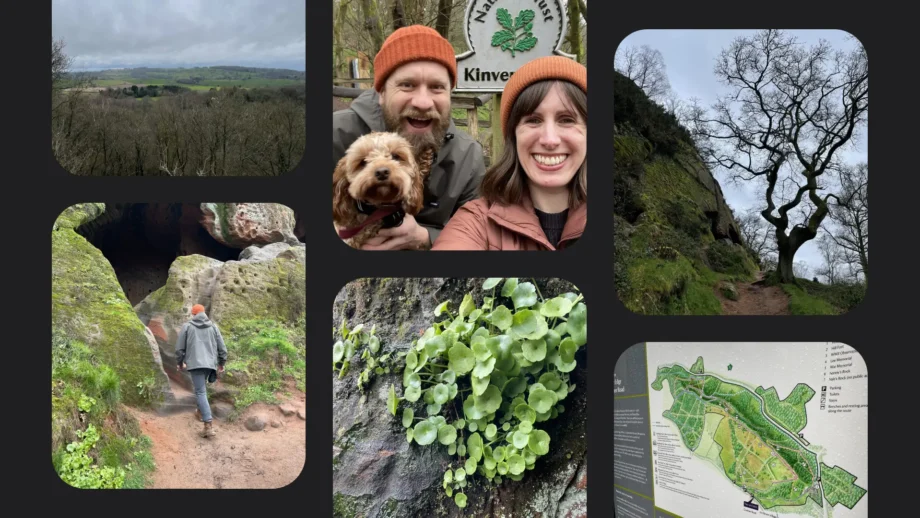
It was a wet morning, but the rain held off just long enough for a two-hour walk at Kinver Edge, a National Trust spot in Staffordshire. We walked through woodland and poked around the caves, with Chris’s dog Maggie leading the way.
At first, we did make small talk. And then a natural lull in conversation prompted… “Shall we give these questions a go, then?”
In advance, we’d taken Optimo’s talk and subsequent article to help us shape a series of questions that felt relevant to us and our business. We asked things like:
- What does our ecosystem look like and how could it become symbiotic?
- Nature is inherently resilient and adaptive. How do we currently handle change – do we adapt or resist?
- Nature does not waste. What does waste look like for us, and how could it become food for another process?
- What would happen if knowledge flowed like nutrients in a mycorrhizal network between us and our clients – who would benefit most, and what are we currently hoarding?
- In nature, diversity equals resilience. How diverse are our teams – not just demographically, but in thinking styles?
- If our client journey were a river, where is water pooling or getting blocked? What obstacles need removing?
These questions took us out of our usual headspace. As business owners, it’s all too easy to focus on the immediate challenges, the high-priorities, the familiar territory – and to do so using the same language, the same framing. These questions didn’t let us do that. They took us somewhere new that, at times, we had to dig quite deep to find answers to.
And being in the woods while talking in metaphors based on the natural world around us – root systems and underground networks, rocks in a river – gave the conversation a vividness it doesn’t usually have. The images made the ideas easier to latch onto.
What the questions surfaced
Over the course of a two-hour walk, we covered a lot of ground (literally and figuratively!). A few themes kept coming up.
Flow
One question asked us to imagine our client journey as a river, and we didn’t have to think too hard about where the water pools. The very start of a project – the scoping, the information gathering, the discovery – is where things most often slow down. We’ve been building better systems to address this, but the walk gave us a clearer way to articulate why it matters: a river blocked at the source affects everything downstream.
Circularity
Nature wastes nothing – everything decomposes into something useful. We’ve not quite reached that point yet – mainly because we don’t instinctively think of intangible things in these terms: the knowledge we accumulate, the processes we refine, the relationships we build. These aren’t always being cycled back in as effectively as they could be. But we’re already taking steps in the right direction – standardising more, reinventing less, and thinking harder about what already exists before we start from scratch.
Nourishment
The mycorrhizal network question – what would happen if knowledge flowed freely between you and your clients? – made us uncomfortable in a productive way. Because we form long-term partnerships, it’s easy to fall into the trap of thinking that delivering a website with training and a user manual, and being on hand for support is enough. But is it? A healthy network doesn’t just make resources available – it actively routes them to where they’re needed. We want our clients to become good website custodians, not just competent WordPress users, and that requires us to be far more intentional about how we share what we know, and when. We’ve got some ideas – watch this space.
Resilience
In nature, resilience comes from diversity – not just of species, but of roles and behaviours. We’ve known from the start that as business partners, our skills, strengths and thinking styles dovetail well. But beyond the two of us, we’ve tended to rely on a close circle of trusted collaborators. That loyalty has value, but it can also be a ceiling. We’re trying to shift toward a more fractional model – bringing in the right expertise for each brief, rather than defaulting to familiarity. More variety in the ecosystem; more capacity to respond to whatever a project needs.
Adaptability
Held up to nature’s standard – respond to your environment, or don’t survive – we’ve adapted quite significantly over the years. Most notably with a relaunch and rebrand, and change of business model. But also with a willingness to embrace new tools and approaches rather than sticking to what we know. Digital is an ever-evolving industry. If the choice is adapt or resist, we’ve always known which side we’re on.
Want to try it yourself?
We didn’t know if anything would come out of our away day other than 10,000 steps and some fresh air. But with the help of the questions and their framing, we came back with a short list of concrete ideas and a stronger shared sense of where our energy wants to go.
It doesn’t need to be elaborate. A question, a walk, and the willingness to think differently is enough to start with. And yes, you could take these questions into a workplace setting as a fresh framing – but there’s something about the act of walking, about being side-by-side rather than face-to-face, about allowing pauses and silences, that really suited the task. Get outside if you can.
If you’re curious, Danielle’s article at Optimo is a great place to begin shaping your own questions. And if you do give it a try, we’d love to hear what comes up for you.
You might not come away with answers. But you’ll probably come away with better questions – and sometimes that’s the more useful outcome.